

Expanding into the Brazilian market offers immense opportunities, but it also requires navigating one of the most complex and protective legal systems in Latin America. For foreign companies, international startups, and global HR departments, understanding the local regulatory environment is not just a matter of administration—it is a critical component of risk management.
Improper hiring practices in Brazil can lead to severe consequences, including:
- Costly labor lawsuits that often favor the employee.
- Substantial back payments for unpaid benefits and taxes.
- Social security penalties and heavy fines from the Federal Revenue Service.
- Reputational risk that can hinder future operations and local partnerships.
To successfully build a workforce in Brazil, companies must align their global strategies with the rigid requirements of the Brazilian Labor Code.
Understanding Brazilian Labor Law (CLT)
The primary legal framework governing employment in Brazil is the Consolidation of Labor Laws (CLT), enacted in 1943. While it has undergone modernizations, its core principle remains the protection of the worker. The CLT applies to almost all private-sector employment relationships and establishes the minimum rights that cannot be waived by individual agreement.
In the eyes of the Brazilian Labor Court, an employment relationship is defined by four specific legal elements. If these are present, the worker is considered an employee under the CLT, regardless of what the written contract says:
- Subordination: The employer directs, supervises, and controls how the work is performed.
- Habituality: The work is performed on a regular, non-occasional basis.
- Personal Service: The work must be performed by that specific individual; they cannot send a substitute.
- Compensation: The worker receives payment (onerosity) in exchange for their labor.
Failing to recognize these elements when hiring “contractors” is the leading cause of labor misclassification claims in Brazil.
Main Steps to Hire an Employee in Brazil
Hiring in Brazil compliance requires a disciplined administrative process. Unlike some jurisdictions where a simple offer letter suffices, Brazil mandates a formal registration flow to ensure the government can track social security and tax obligations in real-time.
- Define Employment Type: Decide between a permanent CLT contract, a temporary contract, or an outsourced model.
- Draft Employment Contract: Create a written agreement in Portuguese (or bilingual) specifying the role, salary, and working hours.
- Register Employee in eSocial: Use the eSocial digital platform to report the hiring to the government before the employee’s first day.
- Enroll in Social Security: Ensure the employee’s PIS/PASEP or CPF is linked to the company’s payroll for INSS contributions.
- Set up Payroll System: Implement a system capable of calculating complex monthly deductions and mandatory benefits.
- Provide Mandatory Benefits: Arrange for transport vouchers, meal allowances, and health insurance where applicable.
Mandatory Employer Contributions
The cost of a Brazil employment contract extends far beyond the gross salary. Employers are responsible for several statutory contributions that significantly increase the “total cost of employment.”
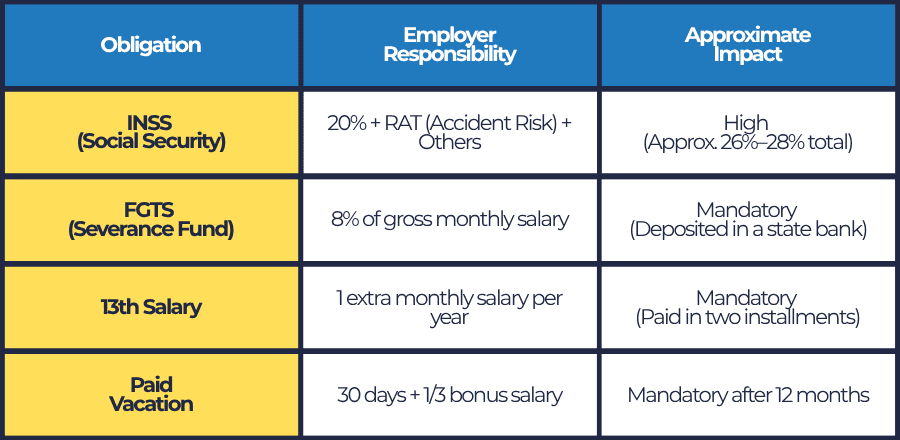
Note: These percentages can vary based on the company’s tax regime (e.g., Lucro Real vs. Simples Nacional) and the specific industry risk factor (RAT).
Employment Contract Types in Brazil

Standard CLT Employment
This is the most common model. It is an indefinite-term contract that provides the full suite of legal protections. It offers the highest level of stability for the workforce but carries the highest tax and administrative burden.
Temporary Contracts
Governed by Law 6,019/74, temporary hiring is only permitted to meet a “transitory need for replacement of regular staff” or an “extraordinary increase in services.” These contracts have strict time limits (usually up to 180 days, extendable by 90).
Independent Contractors (PJ Model)
Many startups attempt to hire via the Independent Contractor Brazil model (known as the PJ or Pejotização model), where the worker opens a company to provide services. While this reduces payroll taxes, it carries a high risk of misclassification. If the “contractor” follows a schedule or reports to a manager, the courts will likely reclassify them as a CLT employee, triggering years of back-taxes and benefits.
Outsourcing
Following the 2017 Labor Reform, companies can now outsource both “middle” and “end” activities. This is often managed through an Employer of Record (EOR) in Brazil, allowing foreign firms to hire locally without a legal entity, provided the third-party provider assumes all labor liabilities.
Risks of Worker Misclassification
The Brazilian legal principle of “Primacy of Reality“ means that what happens in daily practice outweighs what is written in a contract. If a judge sees signs of a subordinate relationship, the written “independent contractor” agreement is nullified.
The consequences of misclassification include:
- Retroactive payment of the 13th salary, vacation, and FGTS for the entire period.
- Unpaid INSS contributions, often with interest and inflation adjustments.
- Moral damages if the court finds the arrangement was designed to defraud labor rights.
“Misclassifying workers in Brazil can lead to significant labor and tax liabilities, often exceeding the original cost of a compliant CLT hire by over 50%.”
Payroll and Compliance Requirements
Payroll in Brazil is highly digitized. The eSocial system is a mandatory federal project that unifies the sending of data regarding workers. Every month, employers must submit:
- Monthly Payroll Filings: Detailed breakdowns of earnings, discounts, and hours worked.
- Social Contribution Payments: Issuance of the DARF for taxes and the FGTS digital guide.
- Termination Procedures: Brazil does not have “at-will” employment in the same sense as the US. Terminating an employee without cause requires the payment of a 40% penalty on the total FGTS balance and a prior notice period.
- Occupational Health (SST): Mandatory medical exams (admission, periodic, and dismissal) must be reported via eSocial to ensure workplace safety compliance.
Cost of Hiring Employees in Brazil
When calculating a budget for a Brazil workforce management strategy, CFOs should estimate that an employee costs approximately 1.6x to 2x their gross salary. This “multiplier” accounts for social security, the 13th salary, vacation bonus, and mandatory benefits like the Vale-Transporte (transportation voucher).
While the gross salary might look competitive on a global scale, the compliance overhead—including legal fees, accounting, and mandatory insurance—must be factored into the initial market entry ROI analysis.
How CLM Controller Supports International Hiring in Brazil

Navigating employment law in Brazil requires local expertise and a proactive approach to compliance. CLM Controller acts as a strategic partner for foreign companies, ensuring that your expansion is built on a solid legal foundation.
We provide comprehensive support, including:
- Payroll Outsourcing in Brazil: Accurate calculation of complex taxes and benefits.
- Labor Compliance Management: Ensuring all eSocial filings are perfect and timely.
- Employment Contract Structuring: Drafting agreements that protect the employer while respecting local law.
- CFO Advisory Support: Helping global leadership understand the financial impact of local labor regulations.
If your company plans to hire employees in Brazil, talk to CLM Controller and ensure full compliance from day one.



0 Comments