
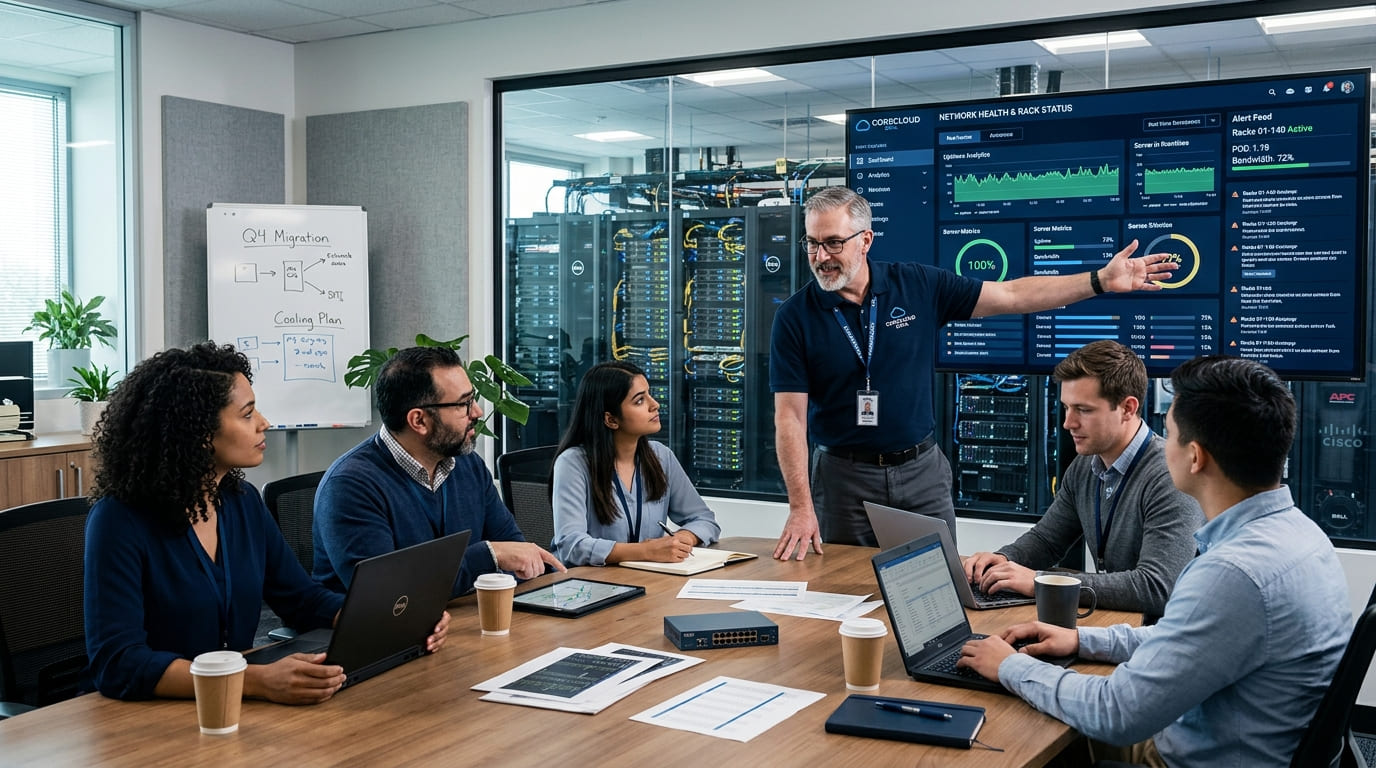
The data center industry is defined by massive capital expenditure (CAPEX) and high-density infrastructure. Operating in Brazil adds layers of complexity, from intricate tax regulations to the logistical challenges of managing high-value hardware across its entire functional life.
For international investors and operators, the disconnect between physical infrastructure and financial reporting is a primary risk. Without a robust financial back-office, tracking the lifecycle of thousands of assets becomes a bottleneck, leading to financial inefficiencies and significant compliance exposure.
Managing a data center in Brazil requires more than technical uptime; it demands financial precision. Aligning asset depreciation, tax credits, and replacement cycles is essential for maintaining profitability and scaling operations in a competitive emerging market.
What is Financial Back-office for Data Centers?

A financial back-office for data centers is a specialized strategic service that integrates accounting, tax management, and procurement with the physical reality of infrastructure. It acts as the bridge between the technical operations team and the corporate financial suite.
This structure ensures that every server, cooling unit, and power distribution component is tracked from the moment of purchase through its eventual decommissioning. It transforms raw operational data into actionable financial intelligence for stakeholders.
Why asset lifecycle management is critical in data centers
In the data center sector, assets do not just exist; they evolve and expire. Equipment depreciation is one of the largest non-cash expenses on the balance sheet. Miscalculating this can lead to distorted profitability reports and overlooked tax saving opportunities.
Replacement cycles in high-performance computing are aggressive. Proper lifecycle management ensures that capital is available for upgrades before hardware failure impacts service level agreements (SLAs). It allows for proactive financial planning rather than reactive crisis spending.
Long-term investment planning depends entirely on understanding the “useful life” of your components. A structured back-office tracks these variables, ensuring that the financial velocity of the business matches the technological pace of the industry.
Financial challenges of data center operations in Brazil
Brazil presents a unique tax landscape where federal and state taxes can significantly inflate the cost of imported hardware. Navigating the “Custo Brasil” requires a financial team that understands how to leverage tax incentives specific to the technology and infrastructure sectors.
High infrastructure costs are exacerbated by inflationary pressures and currency volatility. Without localized financial expertise, international firms often struggle to maintain accurate cash flow projections, leading to budget overruns during expansion phases.
Regulatory compliance in Brazil is notoriously rigorous. From E-Social requirements to specific ancillary tax obligations, data center operators must maintain airtight financial records to avoid heavy fines and legal complications that can stall regional growth.
How financial back-office supports asset lifecycle management
A dedicated financial back-office implements rigorous asset tracking protocols. Each piece of equipment is assigned a unique identifier that links its physical location to its financial history, including purchase price, maintenance costs, and current book value.
Depreciation control is handled with precision, ensuring that the accounting treatment aligns with both Brazilian Generally Accepted Accounting Principles (BR GAAP) and International Financial Reporting Standards (IFRS). This dual-alignment is vital for international reporting.
By centralizing cost allocation, the back-office allows operators to understand the true cost of power, space, and cooling per rack. This granular visibility is the foundation for accurate pricing models and enhanced margin control.
Impact on cash flow, CAPEX, and operational efficiency
The timing of investments is the difference between a profitable quarter and a liquidity crunch. A structured back-office provides the data needed to stagger CAPEX deployments, ensuring that infrastructure grows in lockstep with revenue-generating contracts.
ROI visibility is often clouded by fragmented data. When the financial back-office integrates lifecycle data, leadership can see exactly when an asset has paid for itself and at what point it becomes more expensive to maintain than to replace.
Financial predictability reduces the “risk premium” often associated with Brazilian operations. With clear reporting, companies can secure better financing terms and provide investors with the transparency required for large-scale infrastructure projects.
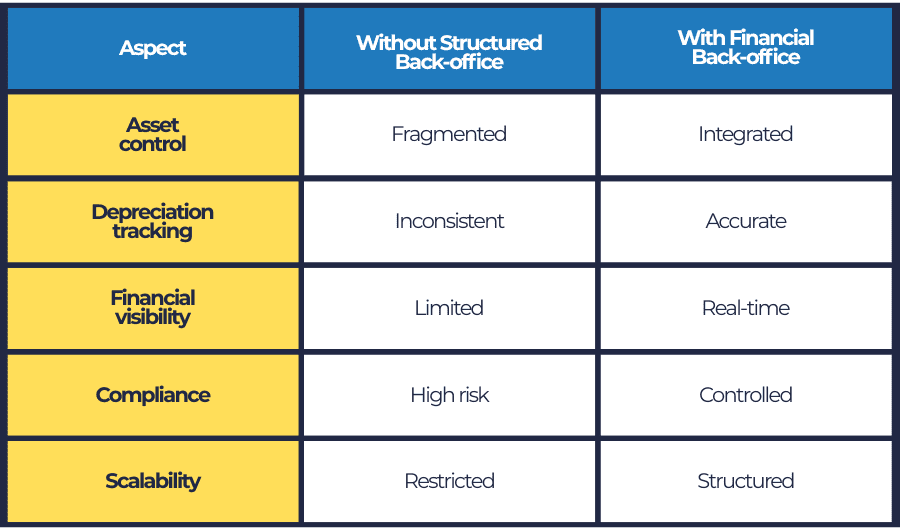
Comparison: Financial Maturity in Data Center Operations
Checklist: Is your data center financial structure scalable?
- Are all assets properly tracked and categorized in a centralized system?
- Is depreciation aligned with both local Brazilian tax rules and international standards?
- Do you have full visibility over the total cost of ownership (TCO) for your lifecycle stages?
- Is your CAPEX planning based on real-time operational data?
- Are your finance and operations departments integrated through shared reporting?
“Data center operations demand financial precision. Without structured asset lifecycle control, companies lose visibility and efficiency,”
explains Rodrigo Ribeiro, Director at CLM Controller.
How to structure financial back-office for data centers in Brazil

To build a successful foundation, companies must first establish rigorous asset management processes. This includes digital tagging and automated inventory reconciliations to ensure the “floor” matches the “books” at all times.
Accounting standards must be localized. This involves configuring ERP systems to handle Brazilian tax substitutions and credits, which can be complex for data centers involving both hardware (assets) and services (colocation).
Integration with operational systems is the final step. The financial back-office should consume data from DCIM (Data Center Infrastructure Management) tools to automate the flow of information, reducing manual entry errors and increasing reporting speed.
When should your company upgrade its financial back-office?
The most common trigger for an upgrade is a new data center deployment or a significant expansion of an existing facility. When the volume of assets grows beyond a certain threshold, manual spreadsheets and generic accounting no longer suffice.
If leadership lacks clear financial visibility or struggles to justify high CAPEX investments to the board, it is a sign that the underlying financial structure is failing. Scaling infrastructure without a scalable financial backend is a recipe for operational gridlock.
Conclusion
A robust financial structure is not just a support function; it is a critical component of infrastructure scalability. In the Brazilian market, the risks of poor asset lifecycle management range from tax penalties to significant capital waste. By prioritizing a specialized financial back-office, data center operators can ensure their investments are protected and their growth is sustainable.
Build Your Financial Foundation in Brazil
CLM Controller is the strategic partner for international data center operators seeking excellence in the Brazilian market. We specialize in Financial Back-office structuring and comprehensive Asset Lifecycle Management, providing the “Equipment as a Service” (EaaS) financial backend required for modern infrastructure. Our scalable BPO solutions ensure that your Brazilian operations remain compliant, transparent, and profitable.
Talk to our specialists and build a scalable financial foundation for your data center operations in Brazil.



0 Comments